
Expected Pose (xP) Explained
xG tracks the ball, not the athlete. Expected Pose uses 3D computer vision to grade a striker's biomechanics at the moment of contact, separating world-class technique from fortunate outcomes.
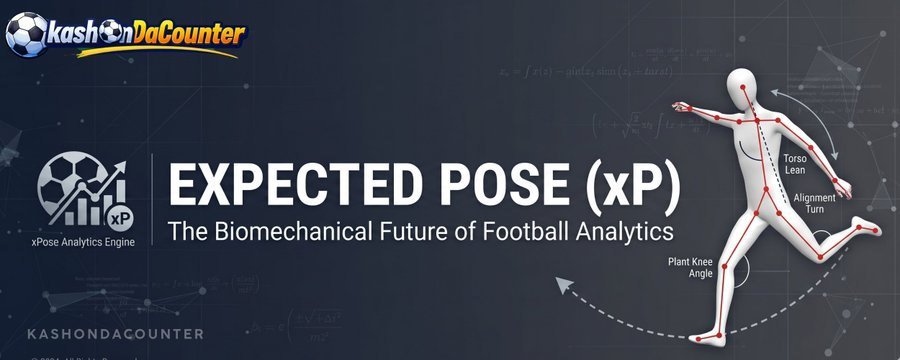
Why Expected Pose (xP) is the next frontier in performance data
Expected Goals (xG) revolutionized how we value chances, but it remains a “post-event” metric: it tracks the ball, not the athlete. While xG tells us where the shot went, it fails to explain why it was successful.
I am introducing Expected Pose (xP): a proprietary framework that utilizes 3D computer vision to quantify the biomechanical efficiency of a striker at the absolute moment of contact. By analyzing the kinetic chain, xP determines if a player’s body shape is optimized for the shot they are attempting, allowing us to separate world-class technique from fortunate outcomes.
The core pillars of xP
The xP model evaluates the three critical hinges of a successful strike. While exact mathematical targets are calibrated to elite Premier League benchmarks, the framework is built upon:
- The Plant Knee Stabilizer: analyzes knee flexion and ground-force vectors to ensure a stable base for maximum energy transfer.
- The Torso Lean Index: a vertical-axis analysis that predicts shot trajectory. This determines whether a strike will be driven low or lost over the bar before the boot even touches the ball.
- The Alignment Engine: a proprietary 3D Z-axis analysis measuring chest and hip rotation. This is the “secret sauce” for understanding how elite players generate the torque required for high-velocity curl.
Autonomous shot classification
A major breakthrough in the xP framework is its ability to auto-classify shot types. The model observes the player’s initial setup and dynamically switches its grading parameters between two distinct mechanical profiles:
1. The Power Profile (laces / driven). Focused on maximum force and “crunch” mechanics. The model prioritizes centre-of-gravity shifts and counter-balance metrics typical of high-volume finishers like Erling Haaland.
2. The Finesse Profile (inside boot / curl). Focused on “opening the gate.” The grading shifts to prioritize 3D body rotation and hip-opening metrics, the true indicators of a high-quality curling effort found in players like Eberechi Eze.
Case study · Finesse Profile: Arjen Robben
In my analysis of archetypes that fit the three different strikes, the xP framework demonstrated its unique value. Traditional 2D video analysis might penalize a “stretched” plant leg, but the xP Alignment Engine identified a perfect rotational signature for a finesse strike.
Analysis snapshot: by utilizing Dynamic Weighting, prioritizing rotational alignment over vertical posture, the model identified a high-probability elite strike. Resulting xP grade: 93.5/100 (Elite category).
▶Watch the goal on XArjen Robben scoring a finesse goal · image rights FC Bayern, Bundesliga
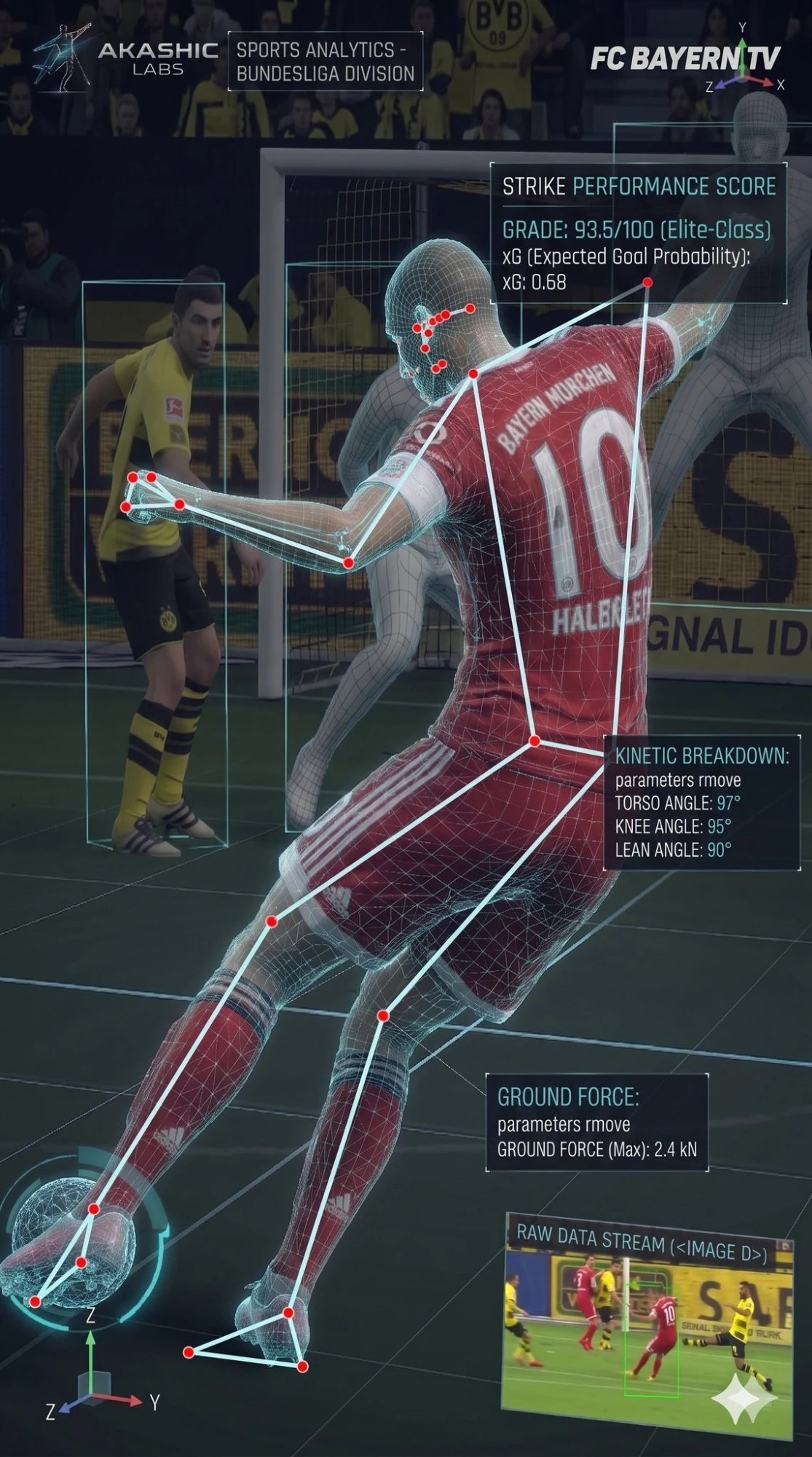
If you were to think of a specialist who replicated form time and time again for a finesse shot, there’s none better than Arjen. The framework here is a beautiful description of how xP can convert the eye test into quantifiable figures.
Case study · Power Profile
The biomechanical standard: Cristiano Ronaldo
Ronaldo is arguably the most studied footballer in history. His “knuckleball” and power drives are a masterclass in full-body tension.
- Key biomechanic: the “Bow” effect. Ronaldo creates a massive stretch-shortening cycle. As his kicking leg cycles back, his opposite arm reaches out and up to counterbalance, creating a diagonal line of tension across his core.
- Engine focus: tracks the hip–shoulder separation. The engine measures the angle between the pelvis and the ribcage at the moment of maximum backswing.
- Ground plant: the engine watches his plant foot. It is usually placed exactly parallel to the ball, acting as a rigid pillar to pivot around.
But it isn’t enough to class Power profiles just in terms of biomechanical standards.
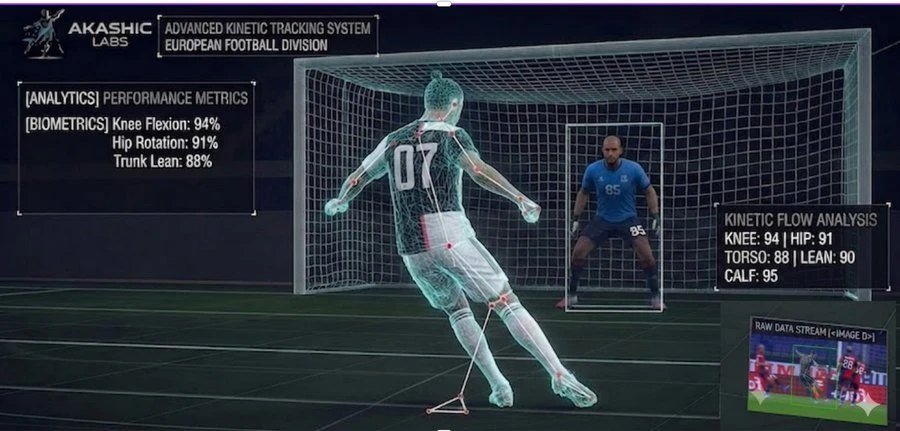
▶Watch the strike on XCristiano Ronaldo · image rights Serie A & Juventus
The torque specialist: Erling Haaland
Haaland is a “power outlier” because of his sheer lever length. Longer limbs usually mean slower “milling” speeds, but he defies this with explosive hip flexion.
- Key biomechanic: hip flexor velocity. Haaland’s power comes from the sheer speed at which his thigh moves from extension (behind him) to flexion (forward).
- Engine focus: knee extension speed. At the moment of contact, the lower leg snaps forward like a whip. The engine can calculate the angular acceleration of the knee joint.
- Leaning: observing how he leans his upper body over the ball to keep the trajectory low despite the massive force.
A perfect example is the following: you can see how knee and torso show good technique, but the alignment of the body is unorthodox, meaning a low xP. The ultimate outlier.
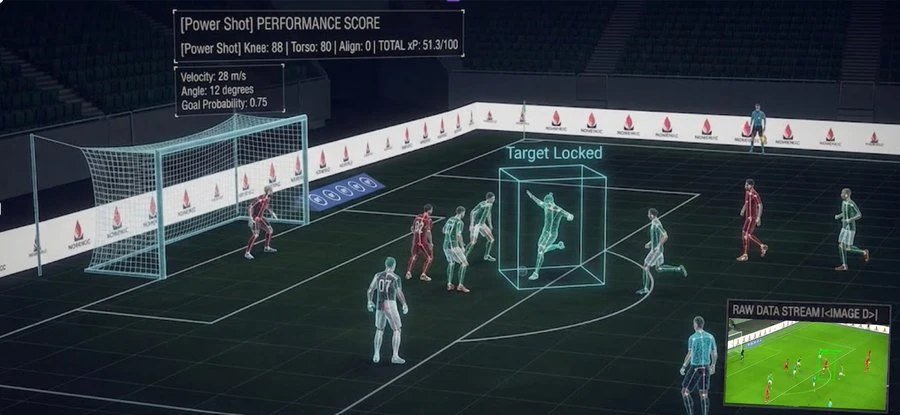 [Power Shot] Knee: 88 · Torso: 80 · Align: 0 · TOTAL xP: 51.3/100
▶Watch the strike on XErling Haaland · image rights Norway TV broadcast
And finally… the technical purist: Kevin De Bruyne
While Ronaldo is about raw athleticism, De Bruyne is about force efficiency. He doesn’t always have a massive backswing, yet the ball travels at elite speeds.
- Key biomechanic: ankle-locked rigidity. Power is lost if the foot is “floppy” at impact. De Bruyne’s ankle is 100% rigid at contact, ensuring all energy from the leg is transferred to the ball.
- Engine focus: the follow-through path. Instead of stopping at the ball, his leg follows a long, controlled arc. The engine can track the “Post-Impact Vector” to see if the energy is directed through the centre of the ball. This is part of the upgrades being made to the 3D analysis of shots.
The value proposition: protecting the edge
The xP framework is built on a custom-weighted algorithm that balances multiple 3D data points. As a proprietary model, the specific degree targets and weighting ratios remain internal to preserve its competitive advantage.
The goal of xP is to move scouting and coaching into a truly predictive space:
- Predictive scouting: identifying young prospects with “pro-ready” striking mechanics before they hit the scoring charts.
- Injury prevention: tracking micro-deviations in a player’s “Strike Signature” that may indicate fatigue or underlying joint stress.
- Technical refinement: providing coaches with objective, biomechanical data to fix “leakage” in a player’s shooting motion.
The future of football is no longer just about where the ball goes — it’s about the pose that put it there.
Implementation and consultation
The xP Framework is currently available for private consultation and league-wide mechanical profiling. For inquiries regarding services or bespoke player reports, contact @kashondacounter or @AkashicLabsLTD on X.